
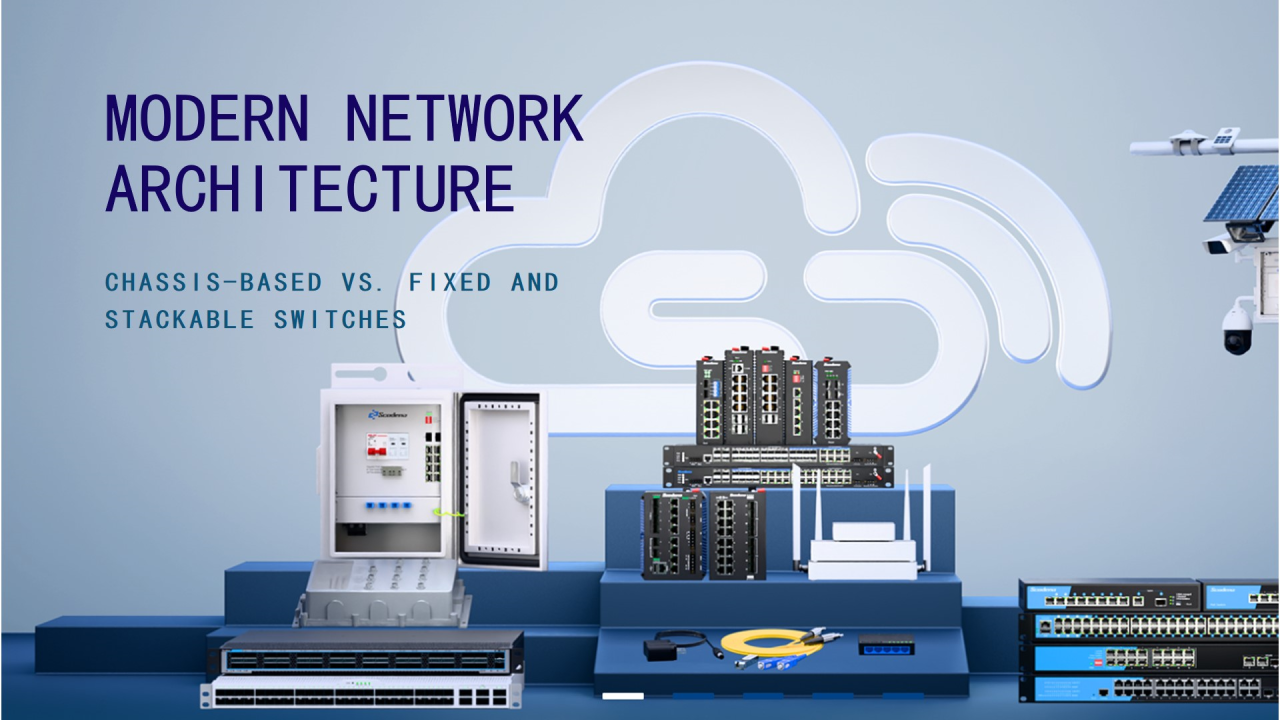
Selecting the appropriate switching infrastructure is a foundational decision in network architecture, with direct implications for scalability, performance, operational efficiency, and total cost of ownership. As networks evolve to support cloud integration, IoT expansion, and bandwidth-intensive applications, the choice between chassis-based, fixed, and stackable switches becomes increasingly critical. This analysis provides a detailed examination of each architecture, offering a framework for selection aligned with contemporary business and technical requirements.
1. Chassis-Based Switches: The Modular Foundation for Core Networks
Architectural Philosophy and Design
Chassis-based switches represent a modular, high-investment approach to network design. The system comprises a central chassis enclosure that houses interchangeable components: supervisor engines, line cards, power supplies, and cooling modules. This design emphasizes centralized resource pooling, maximum port density, and non-disruptive scalability.
Key Advantages and Value Propositions
- Unmatched Scalability and Flexibility: Networks can scale port capacity and functionality by inserting additional line cards, supporting a mix of speeds (1GbE to 400GbE) and media types within a single logical unit. This protects capital investment over long hardware lifecycles.
- Deterministic High Performance: A high-bandwidth, low-latency backplane or fabric provides consistent, wire-speed performance across all ports, essential for data center spine layers, financial trading platforms, and high-performance computing clusters.
- Carrier-Grade High Availability: True redundancy is a hallmark. Dual supervisor engines with stateful failover, N+1 or N+N power and cooling, and ISSU (In-Service Software Upgrade) capabilities enable “five-nines” (99.999%) availability.
- Operational Simplicity through Consolidation: The entire chassis is managed as a single entity, simplifying configuration, policy enforcement (ACL, QoS), and monitoring across hundreds of ports.
Primary Deployment Scenarios
This model is ideally deployed in:
- Enterprise campus and data center core/aggregation layers.
- Service Provider (SP) Point of Presence (PoP) and edge networks.
- Large-scale virtualization and private cloud environments requiring massive east-west traffic capacity.
2. Fixed Switches: The Efficient Workhorse for Network Edge
Definition and Characteristics
Fixed-configuration switches are self-contained, cost-optimized appliances with a predetermined set of ports. Their design prioritizes simplicity, rapid deployment, and low operational overhead in distributed environments.
Compelling Benefits
- Low Total Cost of Ownership (TCO): Significantly lower upfront costs (CapEx) and reduced complexity lead to lower operational expenses (OpEx).
- Energy and Space Efficiency: Compact form factors and optimized power consumption make them ideal for space-constrained wiring closets and environmentally sensitive deployments.
- Deployment Velocity: Their plug-and-play nature accelerates rollout timelines for branch offices, remote sites, and large-scale edge deployments.
Inherent Limitations
Lack of expansion slots limits future adaptability. Performance is capped by fixed ASIC resources, and advanced features or redundancy options are often limited compared to modular platforms.
Optimal Use Cases
- Small to medium-sized business (SMB) access layers.
- Branch office and remote work site connectivity.
- IoT edge networks, digital signage, and dedicated purpose networks (e.g., surveillance, building management).
3. Stackable Switches: Achieving Modular-like Agility at a Lower Entry Cost
Technology Overview
Stackable switches are independent physical units interconnected via high-speed stacking links (dedicated ports or standard uplinks) to form a single logical switch. They share control-plane and management functions while distributing the data plane across units.
Strategic Advantages
- Pay-As-You-Grow Scalability: Capacity can be increased incrementally by adding switches to the stack, offering a flexible and financially staged growth path.
- Enhanced Resiliency: Features like multi-chassis link aggregation (e.g., MLAG, vPC) provide node-level redundancy, preventing a single switch failure from causing a total site outage.
- Unified Management Domain: Administrators manage the entire stack through one IP address and configuration file, drastically simplifying provisioning, updates, and troubleshooting.
Critical Considerations and Potential Drawbacks
- Stack Bandwidth Constraints: Inter-unit traffic is limited by the aggregate stacking bandwidth, which can become a bottleneck for latency-sensitive or storage traffic.
- Stack Stability Risks: “Split-brain” scenarios can occur if stacking links fail, potentially creating network loops or duplicate IP addresses.
- Disruptive Upgrades: Firmware upgrades often require rebooting the entire logical stack, necessitating maintenance windows.
- Geographic Limitations: Stacking cable length restrictions typically confine members to the same or adjacent racks.
Ideal Application Environments
- Mid-sized enterprise campus aggregation and access layers.
- Small to medium data center top-of-rack (ToR) deployments.
- Growing organizations that need more scalability than fixed switches offer but lack the budget or scale for a full chassis-based solution.
4. A Strategic Framework for Switch Selection
Moving beyond simple feature comparison, selection should be guided by a structured analysis of business and technical drivers:
- Assess Growth Trajectory & Scale: Project port and bandwidth requirements for a 5-7 year horizon. Linear, predictable growth may suit stackables; large, unpredictable expansion favors chassis-based designs.
- Define Performance & Resilience Requirements: Evaluate needs for throughput, latency, and uptime. Mission-critical cores demand chassis-based redundancy; many edge sites can tolerate the simpler resilience of fixed or stackable systems.
- Analyze Total Cost of Ownership (TCO): Calculate not only initial purchase price but also costs for power, cooling, space, management overhead, and future upgrades over the asset’s lifespan.
- Evaluate Operational Model and Skillset: Consider your team’s ability to manage complexity. Chassis switches offer centralized control but require deeper expertise; fixed switches reduce operational burden.
- Align with Architectural Direction: Ensure the choice complements broader initiatives like Software-Defined Networking (SDN), network automation, and intent-based networking. Look for API support (RESTCONF/NETCONF, gNMI) and programmability.
5. The Future-Proof Network: Looking Ahead
The evolution of switching is increasingly defined by software. The chosen hardware platform must serve as a robust, programmable foundation for:
- Automation and Orchestration: Enabling infrastructure-as-code practices for consistent, error-free deployment and changes.
- Telemetry and Analytics: Streaming granular data (via gNMI, etc.) to AIOps platforms for predictive analytics and proactive fault detection.
- Open Integration: Supporting standard protocols and APIs to integrate seamlessly with cloud management platforms and SDN controllers.
- Sustainability: Adhering to energy-efficient designs (e.g., EEE, advanced power management) to reduce environmental impact and operational cost.
Conclusion
There is no universally “best” switch architecture. The optimal choice emerges from a careful alignment of technology capabilities with specific organizational priorities.
- Chassis-Based Switches remain the undisputed choice for environments where maximum performance, scalability, and availability are non-negotiable, justifying their higher initial investment.
- Fixed Switches offer unparalleled cost-efficiency and simplicity for static, cost-sensitive edge deployments, forming the vast fabric of the connected world.
- Stackable Switches effectively bridge the gap, delivering a compelling balance of scalable capacity, operational simplification, and improved resilience for the growing mid-market.
In an era defined by digital transformation, the network is a strategic asset. A deliberate, informed selection of switching infrastructure—one that balances present needs with future agility—is essential for building a resilient, efficient, and intelligent network ready to meet tomorrow’s challenges.