
Welcome to the fascinating world of fiber optics! If terms like PON, OLT, and ONT sound like alphabet soup, you’re in the right place. At Quanwave, we live and breathe this technology, and we’re passionate about sharing what we’ve learned over the years. Think of this not just as an article, but as a conversation—a way for us to pass on our experience to newcomers, engineers, and curious minds alike.
Let’s pull back the curtain on the magic behind fast, reliable fiber internet.
Part 1: What is PON, and Why Should You Care?
Imagine a single highway of light that seamlessly branches off to deliver data to hundreds of homes—without a single traffic light or powered intersection. That, in essence, is a Passive Optical Network (PON).
Unlike active networks that need powered equipment every step of the way, a PON uses clever, passive splitters (think of them as “light dividers”) to distribute a signal. This makes the network simpler, more reliable, and incredibly efficient. The two most common “rules of the road” are GPON and EPON, but the core idea is the same: brilliant, streamlined connectivity.
Part 2: The Core Quartet: Meet the Team
Every great PON system relies on a perfect harmony between four key players. Let’s meet them.
The Command Center: Optical Line Terminal (OLT)
If the PON were a symphony, the OLT is the conductor. It lives at your service provider’s central office.
- What it does: The OLT is the starting and ending point for all data. It takes internet, voice, and video traffic from the broader network and broadcasts it downstream to every user. Conversely, it gracefully collects and aggregates data coming upstream from all the homes and businesses connected to it.
- Why it’s brilliant: Beyond just moving data, the OLT is a smart manager. It allocates bandwidth fairly, ensures quality of service, and provides a centralized platform to monitor and manage the entire network. It’s the brain and the brawn, working tirelessly behind the scenes.
The Bridge to Your Home: Optical Network Unit (ONU) / Terminal (ONT)
This is your personal gateway. The ONU or ONT sits at your premises (often on a wall inside your home).
- What it does: This device performs a crucial translation. It converts the optical signals coming through the fiber into electrical signals that your phone, computer, and TV can understand (and vice-versa).
- A quick note on names: You might hear both ONU and ONT. They are functionally the same—your customer-side equipment. The difference is often subtle and related to standards bodies (ITU-T vs. IEEE). For most practical purposes, you can think of them interchangeably. At [Your Company Name], we engineer these to be robust, efficient, and easy to use.
The Unsung Hero: Optical Distribution Network (ODN)
This is the physical road map—the actual highway of glass and light that connects everything.
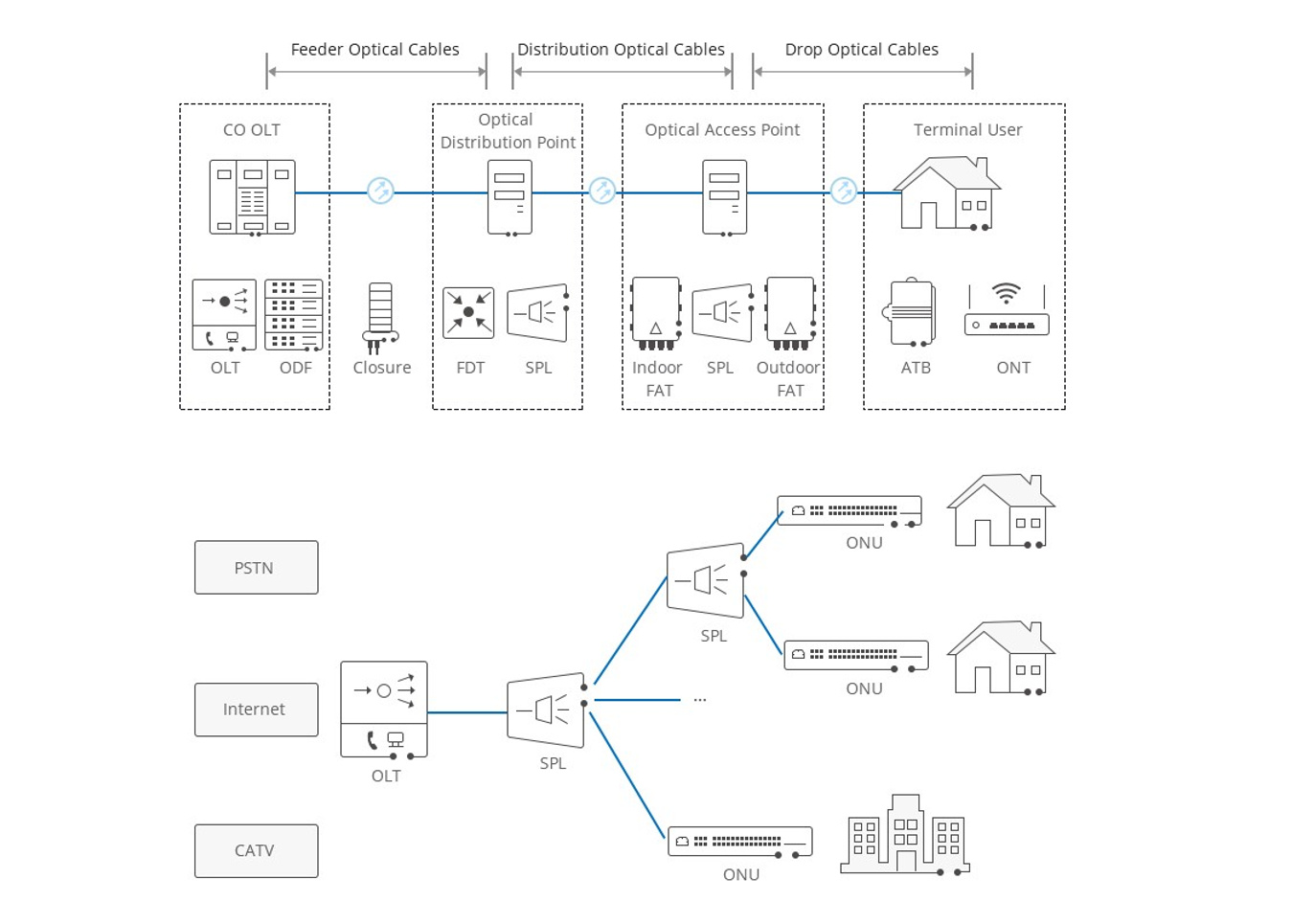
- What it is: The ODN is the complete passive fiber infrastructure between the OLT and your ONT. It includes the cables, connectors, and most importantly, the optical splitters.
- Why it matters: The ODN’s quality is everything. A well-designed ODN ensures the signal stays strong and clear over distances of 20 km or more. It’s divided into segments: the long feeder fiber, the distribution fibers that branch into neighborhoods, and the final drop fiber that comes right to your home. We take immense pride in designing and supporting ODNs that are built to last and perform.
Part 3: How It All Comes Together: A Real-World Picture
Let’s visualize a typical FTTH (Fiber to the Home) setup:
- The OLT at the provider sends a stream of data down a single fiber.
- That fiber reaches a passive splitter (part of the ODN) in a neighborhood cabinet. This splitter divides the light signal, copying it to multiple output fibers.
- One of those fibers becomes the dedicated drop to your house.
- It connects to your ONT, which translates the light into a format your router can use, delivering blazing-fast internet, crystal-clear VoIP, and seamless IPTV to every device in your home.
Part 4: Why We Believe in PON
After years in this industry, our enthusiasm for PON technology only grows. Here’s why:
- Elegant Simplicity: With no active components in the field, the network is incredibly reliable and requires less maintenance.
- Future-Ready Scalability: It’s brilliantly cost-effective to add a new subscriber—just run a fiber to the splitter.
- Immense Capacity: A single OLT port can serve dozens of homes with gigabit+ speeds, ready for 5G backhaul, IoT expansion, and whatever comes next.
Conclusion: More Than Just Technology
Understanding PON is about seeing the elegant architecture that makes modern connectivity possible. At [Your Company Name], we don’t just sell components like OLTs and ONUs; we provide the expertise and reliable solutions that make these networks hum.
We wrote this guide because we believe an informed community is a stronger one. Whether you’re an engineer designing a network, a technician in the field, or a tech enthusiast, we hope this shed some light on the incredible technology working for you, silently and efficiently, every single day.
Have questions about PON or your specific network challenges? Let’s talk. We’re here to help, powered by experience and a genuine passion for making connections better.
This insight is brought to you by the team at Quanwave— where deep technical expertise meets a commitment to clear, human communication.